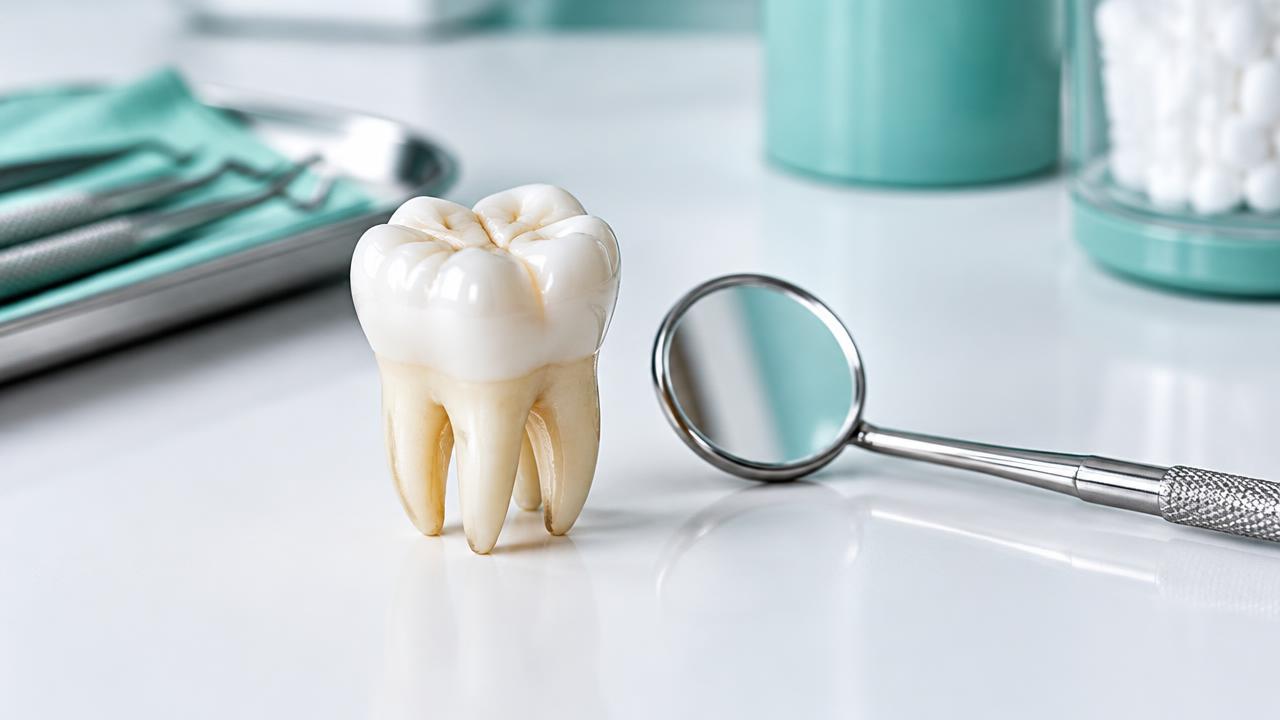
P11-4 dental peptide research concerns early enamel lesions, not regrowing teeth. Compare human studies, fluoride co-treatment and evidence limitations.
P11-4 is a self-assembling dental peptide studied for early enamel lesions. Human studies support potential remineralization and lesion inactivation. They do not demonstrate regrowth of missing teeth or reconstruction of large cavities.
Evidence checked October 21, 2026. This article explains dental research, not a DIY dental procedure. A dentist needs to distinguish an early lesion from a cavity requiring other care.
What is P11-4, and where does Curodont fit?
P11-4 is studied as a peptide scaffold intended to support mineral deposition in an early caries lesion. Curodont is a product name encountered in this literature; a branded treatment and an isolated peptide are not automatically equivalent interventions.
We separate the proposed mechanism from the patient outcomes. A laboratory scaffold can suggest why something might work. It cannot by itself establish fewer cavities, restored enamel architecture or whole-tooth regrowth.
Remineralization is not regrowing a tooth
An early enamel lesion can retain a surface while losing mineral below it. That differs from a large cavity with missing tissue. The clinical studies below concern early lesions, not replacing a lost tooth.
Our evidence table distinguishes visible changes, lesion activity and fluorescence readings from direct proof of rebuilt enamel. Those endpoints should not be collapsed into a single “regeneration success rate.”
What have human studies found?
| Study | Participants and follow-up | What was reported | What weakens certainty |
|---|---|---|---|
| Brunton et al., 2013 | 15 healthy adults with Class V white-spot lesions; 180 days | Lesion-size improvement at day 30, p=0.02; 11 adverse events, two possibly protocol-related | Small, uncontrolled safety study; no secure attribution of improvement to peptide |
| Doberdoli et al., 2020 | 90 children/adolescents randomized to three groups; 360 days | ICDAS partial regression at day 360: 6.7% with peptide plus fluoride varnish, 20.0% with peptide plus peptide-matrix care; control had 23.3% partial progression | Different co-treatments, single blinding and attrition; regression and progression are different outcomes |
Primary sources: Brunton's clinical safety trial and Doberdoli's randomized trial, open full text.
The 6.7%, 20.0% and 23.3% figures do not form a clean leaderboard. The first two describe partial regression; the third describes partial progression. We retain those labels because reversing a lesion category and avoiding progression are not the same endpoint.
Can the trials isolate the peptide's effect?
Not completely. The 2020 study evaluated treatment regimens that included fluoride varnish or peptide-matrix care, rather than a simple isolated-peptide-versus-identical-placebo comparison.
The registry is NCT03780270. The paper reports registration on December 19, 2018, after study completion in December 2016. Retrospective registration makes it harder to check whether outcomes were prespecified. It does not automatically invalidate the result, but it belongs beside it.
The paper also includes a manufacturer-affiliated coauthor. We report that relationship because commercial involvement matters when judging a small evidence base, not because it proves a result is wrong.
What would stronger evidence look like?
Longer randomized studies should measure outcomes that matter to patients, such as progression to cavitation or need for restoration, while keeping background care comparable. Patient counts and lesion counts should be reported separately when several teeth are assessed in the same person.
We would also want to know whether an apparent improvement persists and whether it applies across lesion sites and patient groups. Results in early occlusal lesions do not automatically establish the same effect in orthodontic white spots or deeper lesions.
P11-4 is a dental evidence topic, not an injectable protocol
The cited human studies concern local dental interventions. They are not evidence for injecting P11-4, systemic effects or home preparation. Research reporting should not turn a dental product study into an online peptide administration guide.
Our broader research blog keeps study summaries separate from store offers. For a different example of how headline numbers depend on the endpoint, read UBT251's phase 2 evidence.
Sources
Frequently asked
Related Articles


New guides, by email
New compound guides and research notes when we publish them. No set schedule. Unsubscribe anytime.
No spam. Unsubscribe anytime.
Evidence notes from published research and trial registries. Educational information, not medical or dental advice.